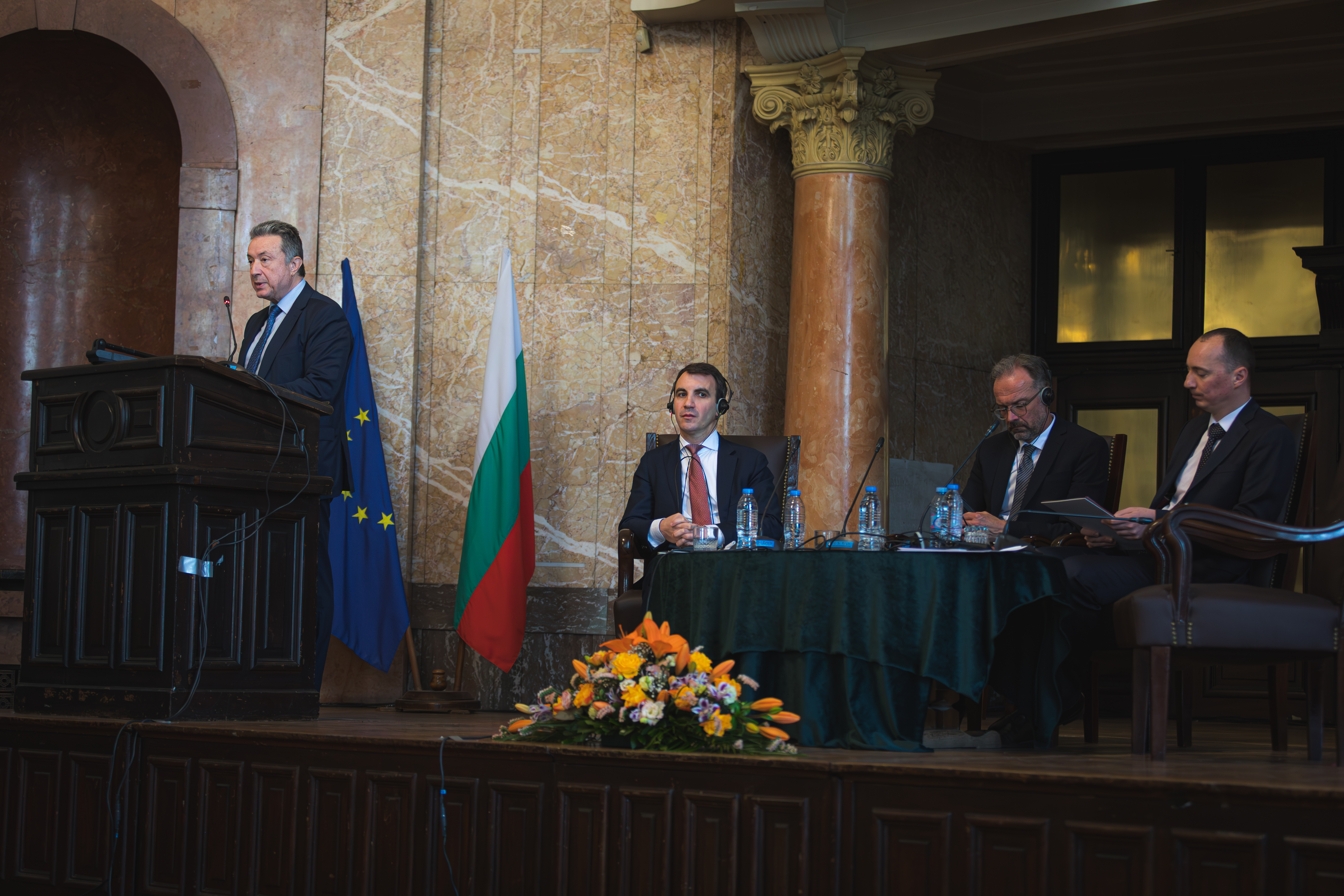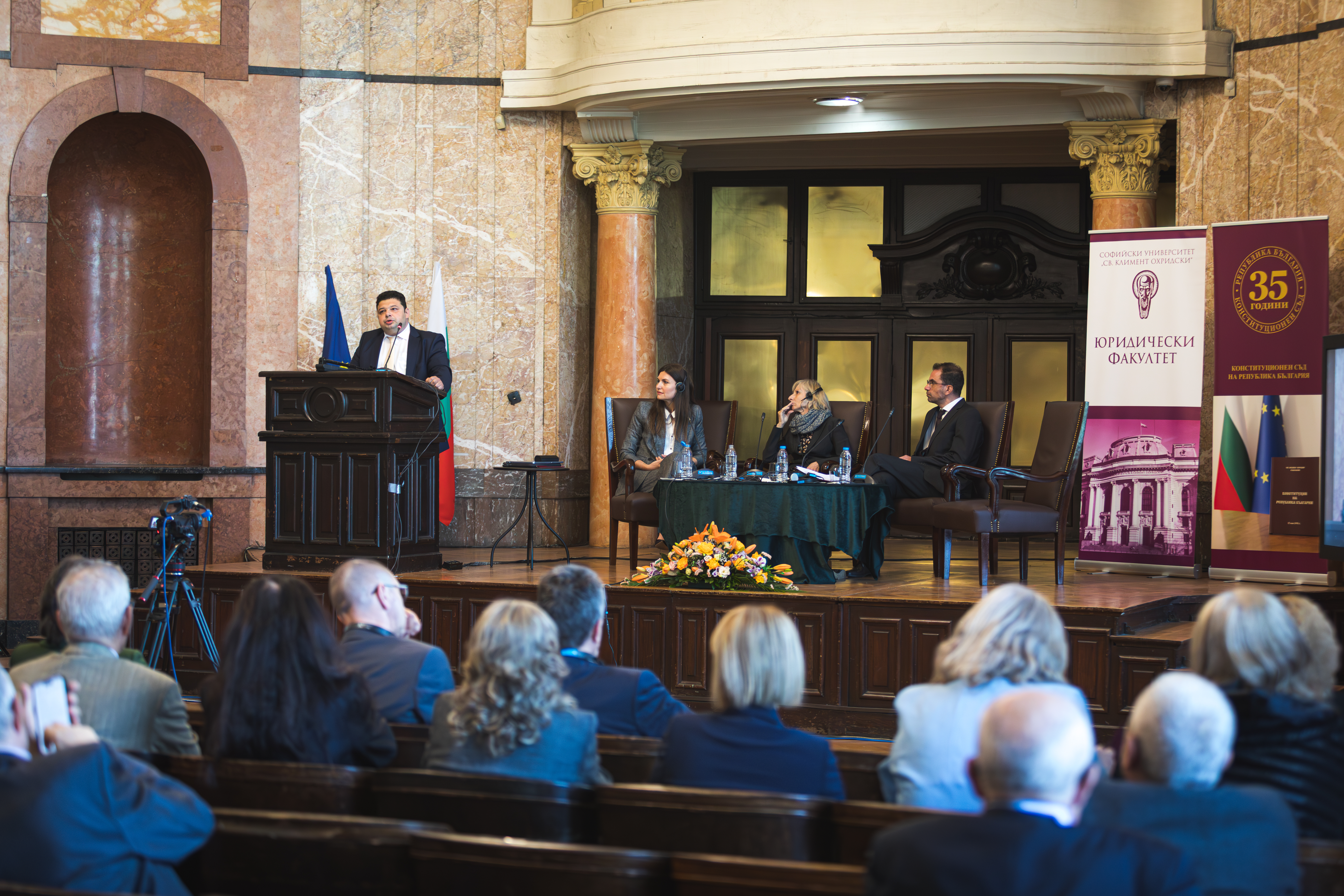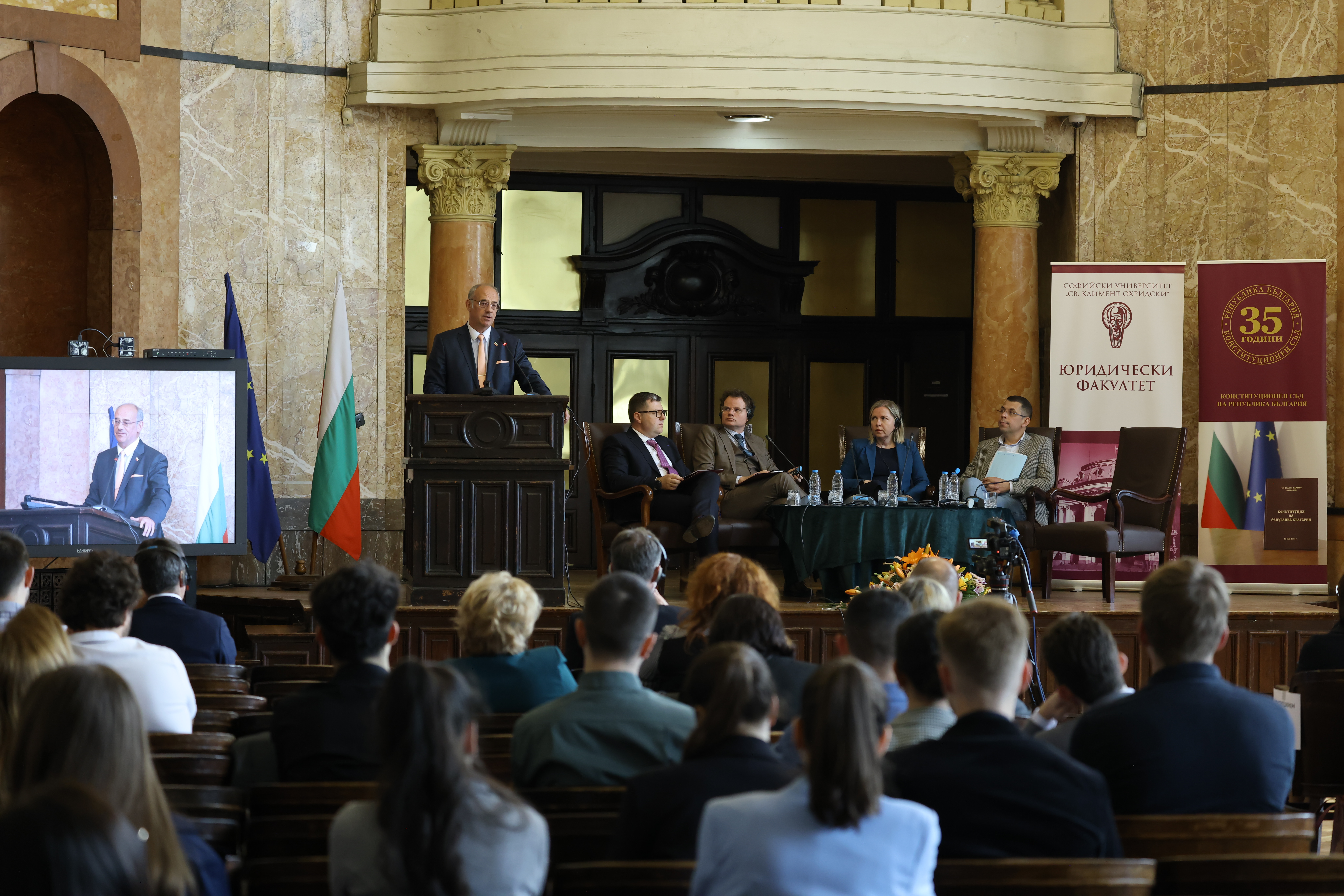
The international academic conference is part of the events celebrating the 35th anniversary of the Constitutional Court
The Constitutional Court and Sofia University “St. Kliment Ohridski” organized the first open professional discussion of its kind, featuring constitutional judges, representatives of the academic community, and guest lecturers from universities in France, Belgium, Italy, Hungary, and Poland. The international academic conference celebrating the 35th anniversary of the Constitutional Court’s establishment was dedicated to current and key issues in constitutional justice.
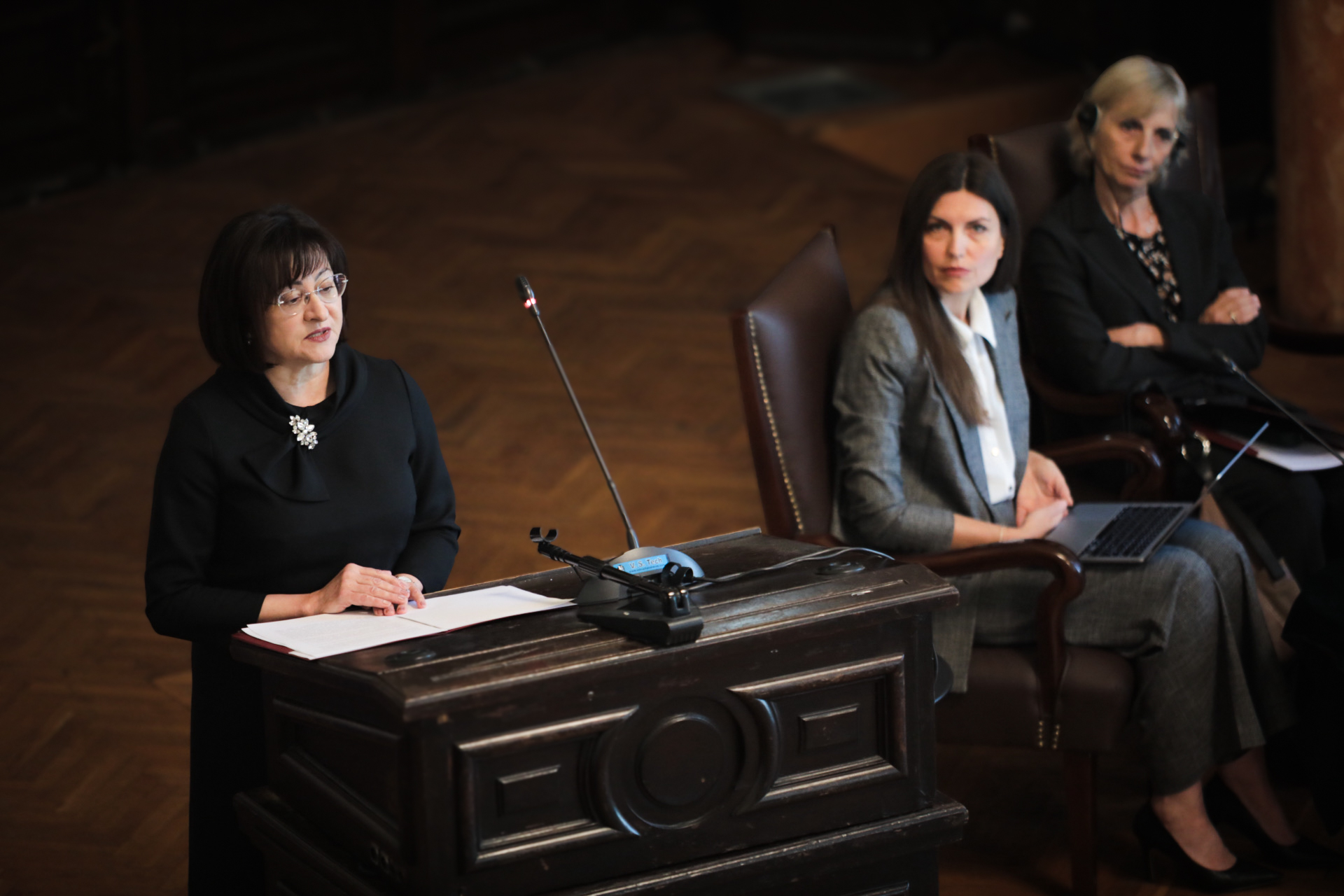
The President of the Constitutional Court, Pavlina Panova, and the Associate Dean of the Faculty of Law, Prof. Dr. Evelina Stoeva-Dimitrova, opened the forum.
In her speech, Pavlina Panova emphasized the role of the Faculty of Law at Sofia University, which has trained nearly all constitutional judges and is shaping the new generation of lawyers. “It is right here, in these lecture halls, that free, critical, and open minds are formed,” she noted. Pavlina Panova emphasized the significance of the 1991 Constitution and constitutional justice as an instrument of particular importance for guaranteeing a democratic constitutional state governed by the rule of law.
“The role of the Constitutional Court is to shape and lead the debate on constitutional judicial review, its legitimacy, legal mechanisms, prospects, and the challenges facing its development,” Prof. Dr. Evelina Stoeva-Dimitrova stated in her welcoming remarks.
The first panel of the conference was devoted to the legitimacy of constitutional courts in Europe. Associate Professor Natasa Danelciuc-Colodrovschi from Aix Marseille University presented the argument that the independence of constitutional courts is closely linked to their social legitimacy and public trust. Prof. Angela Di Gregorio from the University of Milan analyzed the selection of constitutional judges in Central and Eastern Europe, emphasizing the risk of politicization of constitutional courts.
Constitutional Judge Orlin Kolev presented the topic “The Legitimacy of the Constitutional Court of the Republic of Bulgaria: Evolution and Prospects.” He reviewed issues that were on the agenda when previous constitutions were drafted but remain relevant today, and emphasized that the prospects for constitutional justice are directly linked to the challenges of the times.
The second panel was devoted to the legal force and enforcement of constitutional court rulings. Prof. Jan Theunis of Hasselt University, a referent at the Constitutional Court of Belgium, presented the Belgian Constitutional Court’s shift toward a more pragmatic approach, incorporating techniques such as partial repeal of provisions, maintaining the effect of repealed texts, and addressing legislative gaps. Assoc. Prof. Basile Ridard from the University of Lille examined the practice of the French Constitutional Council and the mechanism for the deferred effect of decisions.
Constitutional Judge Yanaki Stoilov presented the concluding report during the second panel on the topic “Legal Force, Effect, and Enforcement of Decisions of the Bulgarian Constitutional Court.” He outlined the main characteristics of the Constitutional Court’s decisions, the most important of which is their effect on all state bodies, legal entities, and citizens. In this way, the Court upholds the unity of the legal system under the supremacy of the Constitution, noted Prof. Stoilov, and highlighted a problem: unlike other branches of law, constitutional law lacks a mechanism for compulsory enforcement.
The open discussion in the university auditorium continued with the topic „Application of European Union Law by Constitutional Courts and their Relationship with the Court of Justice of the European Union“.
Associate Professor Hristo Hristеv discussed the primacy of European Union law in the practice of national constitutional courts and noted that when points of tension arise between the practice of constitutional courts and that of the Court of Justice of the European Union, the way to resolve them is through preliminary rulings.
His colleague from the University of Szeged, Assoc. Péter Pál Kruzslicz, presented the Hungarian experience and EU law, noting that the Constitutional Court of Hungary is broadly empowered, including with the authority to rule on the conformity of EU law with the country’s constitution, but prefers to make creative interpretations of the Fundamental Law.
Prof. Monika Florczak-Wątor from Jagiellonian University presented a report on the application of EU law in times of crisis and the practice of the Polish Constitutional Tribunal. She emphasized that since 2016, due to political issues regarding its independence, the institution has undergone drastic changes and altered its approach to European legislation.
The third presentation in the final working panel of the conference, titled „Does the Bulgarian Constitutional Court apply EU law? If so, how? If not, why not?“, was delivered by Constitutional Court Judge Atanas Semov. He highlighted three key points. The Constitutional Court does not apply EU law, but applies—in the strict sense of the term—only three legal acts: the Constitution, the Constitutional Court Act, and its internal rules of procedure. The Constitutional Court lacks the authority to rule on the conformity of a law or other act of domestic law with EU law. It is of key importance to properly understand the difference between “application” and “compliance.”
Prof. Semov emphasized that the Constitutional Court may refer a question for a preliminary ruling to the Court of Justice of the European Union, and this will be done as soon as there is a valid basis in a specific constitutional case.