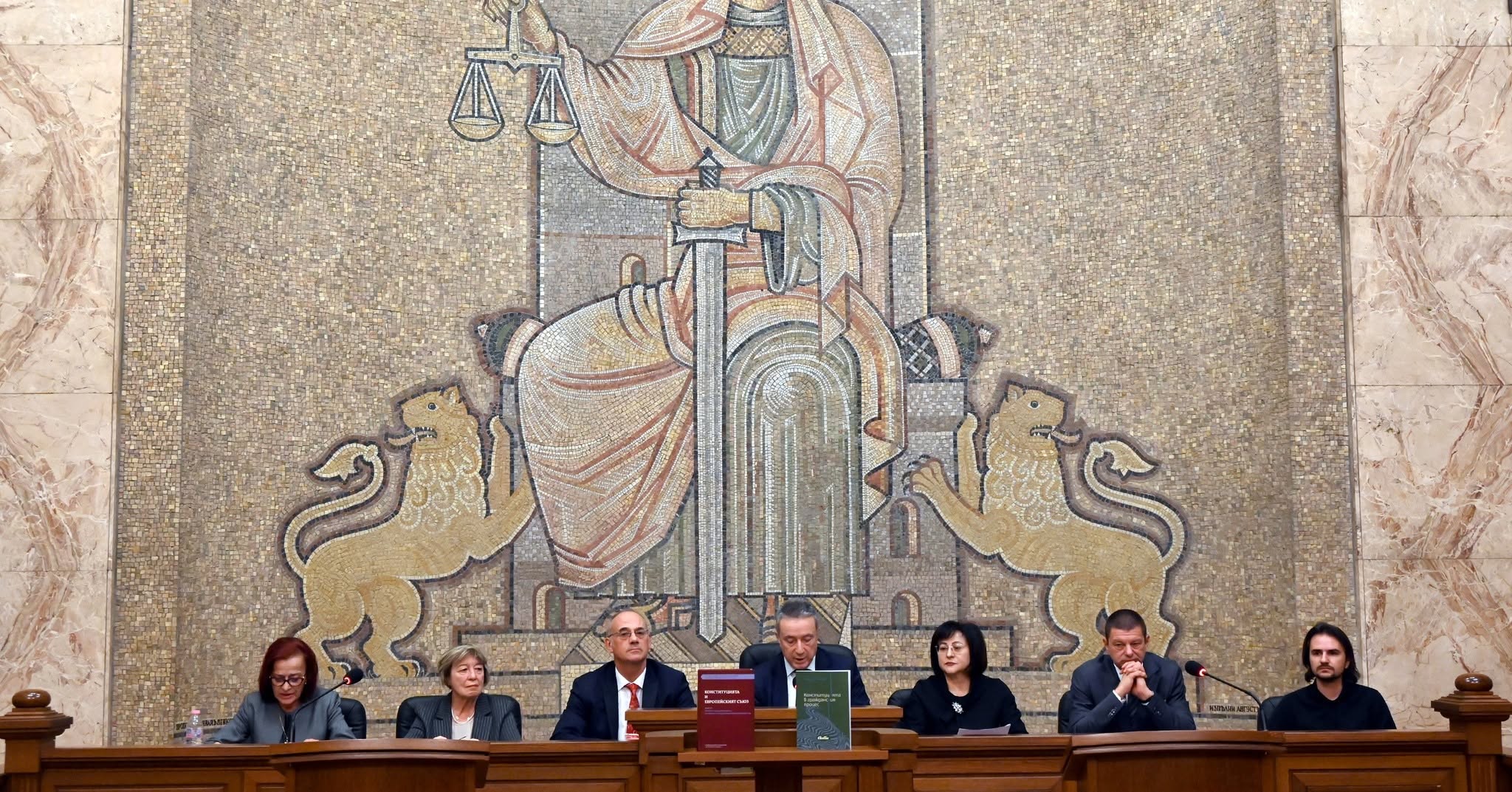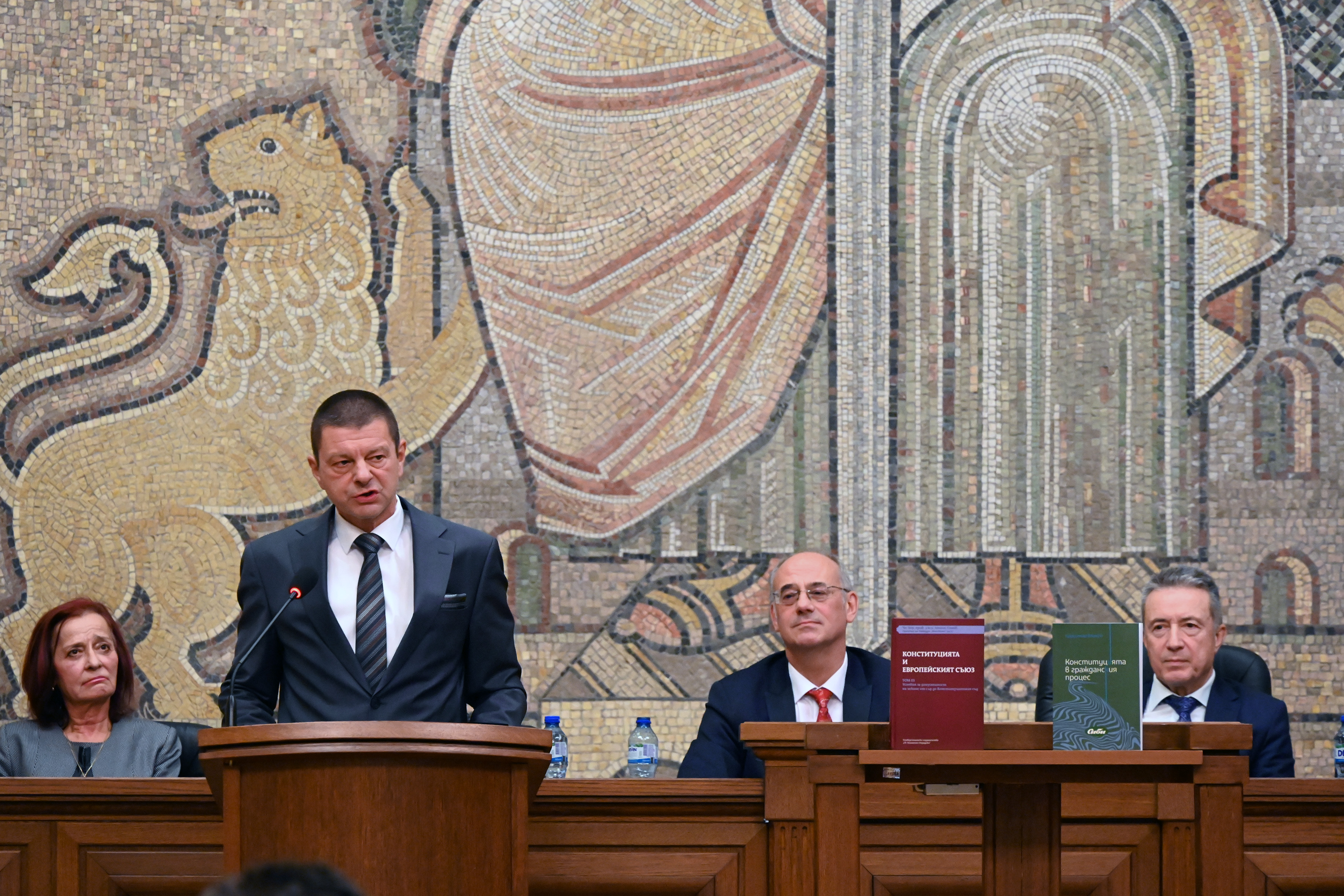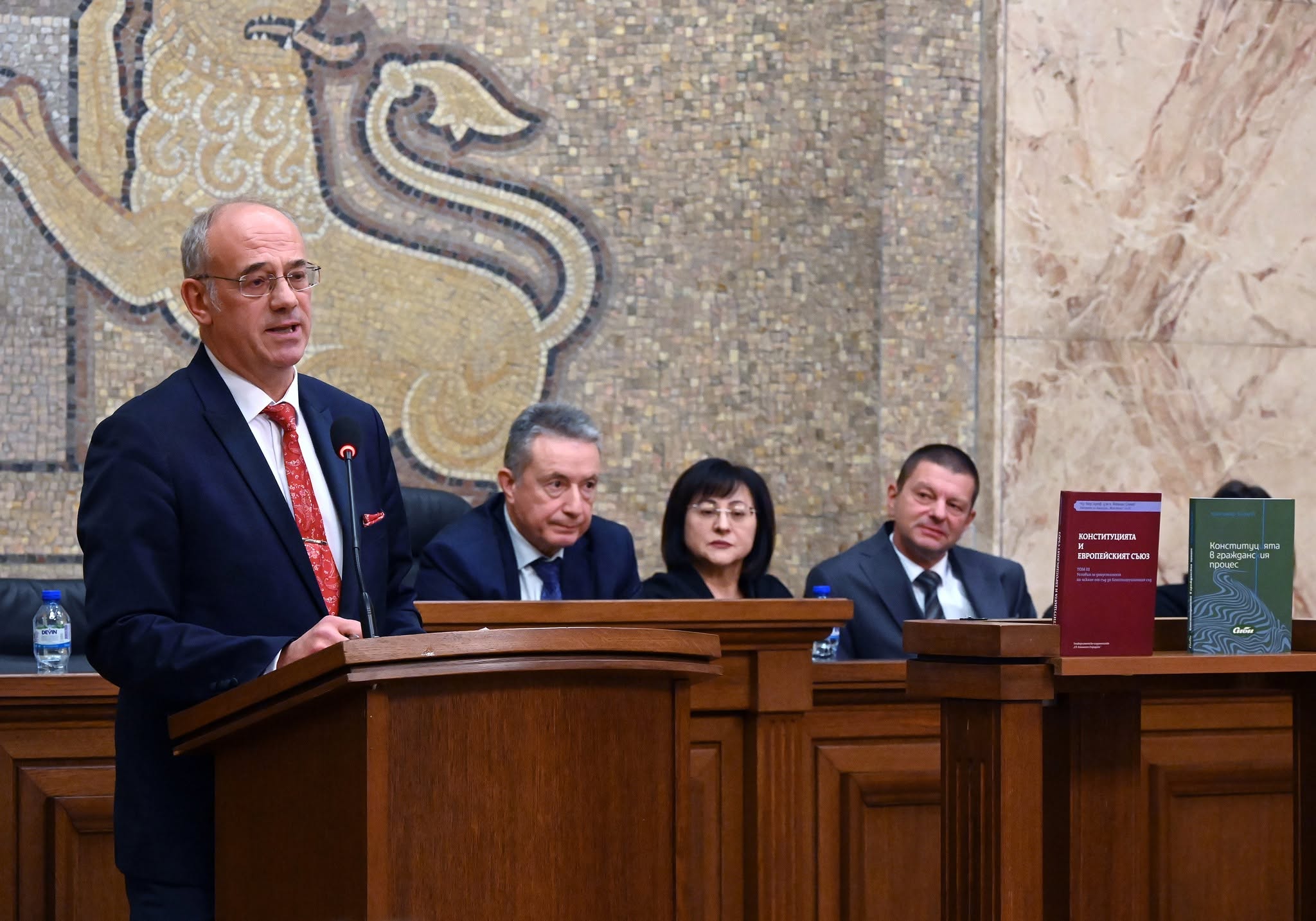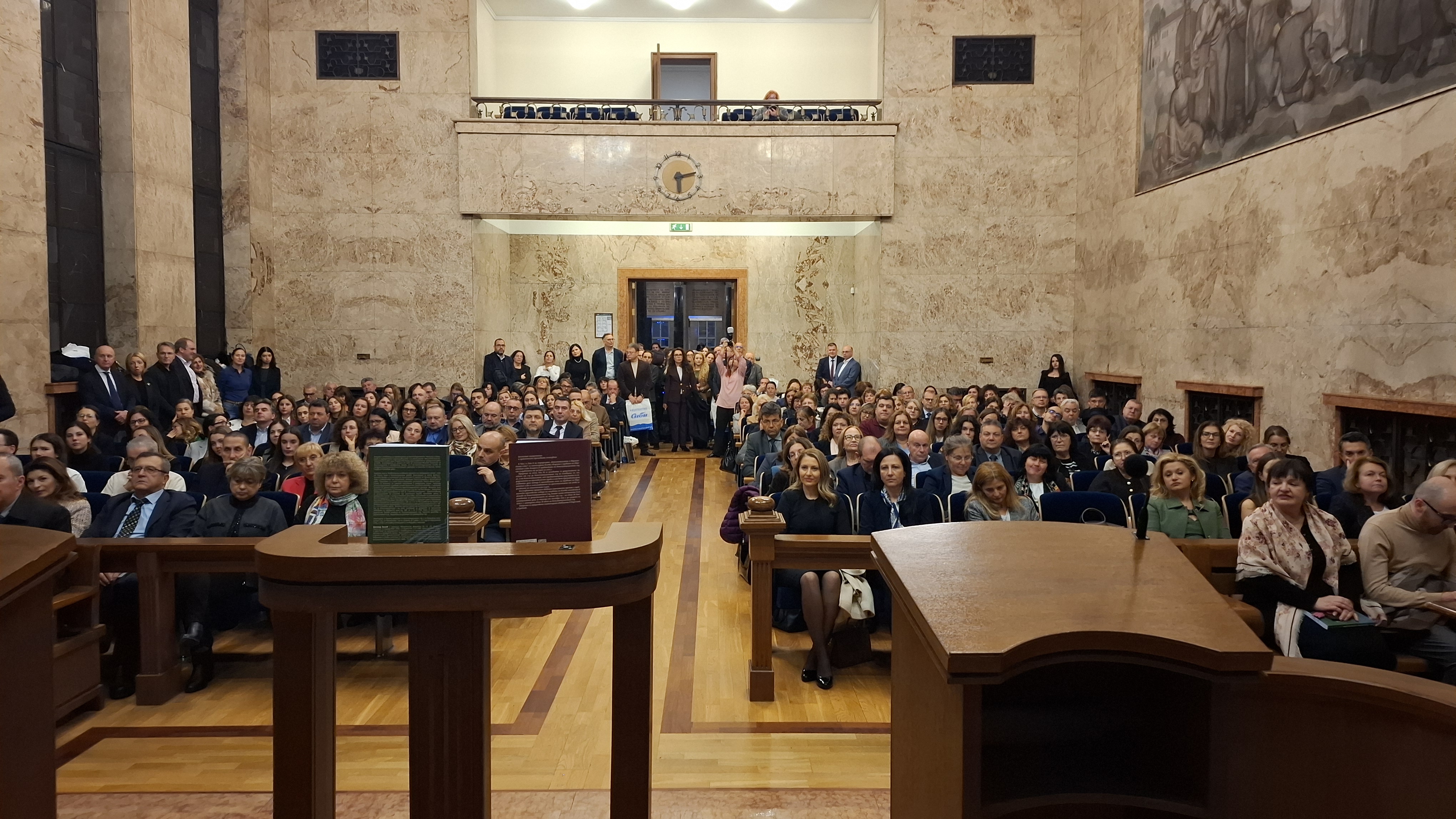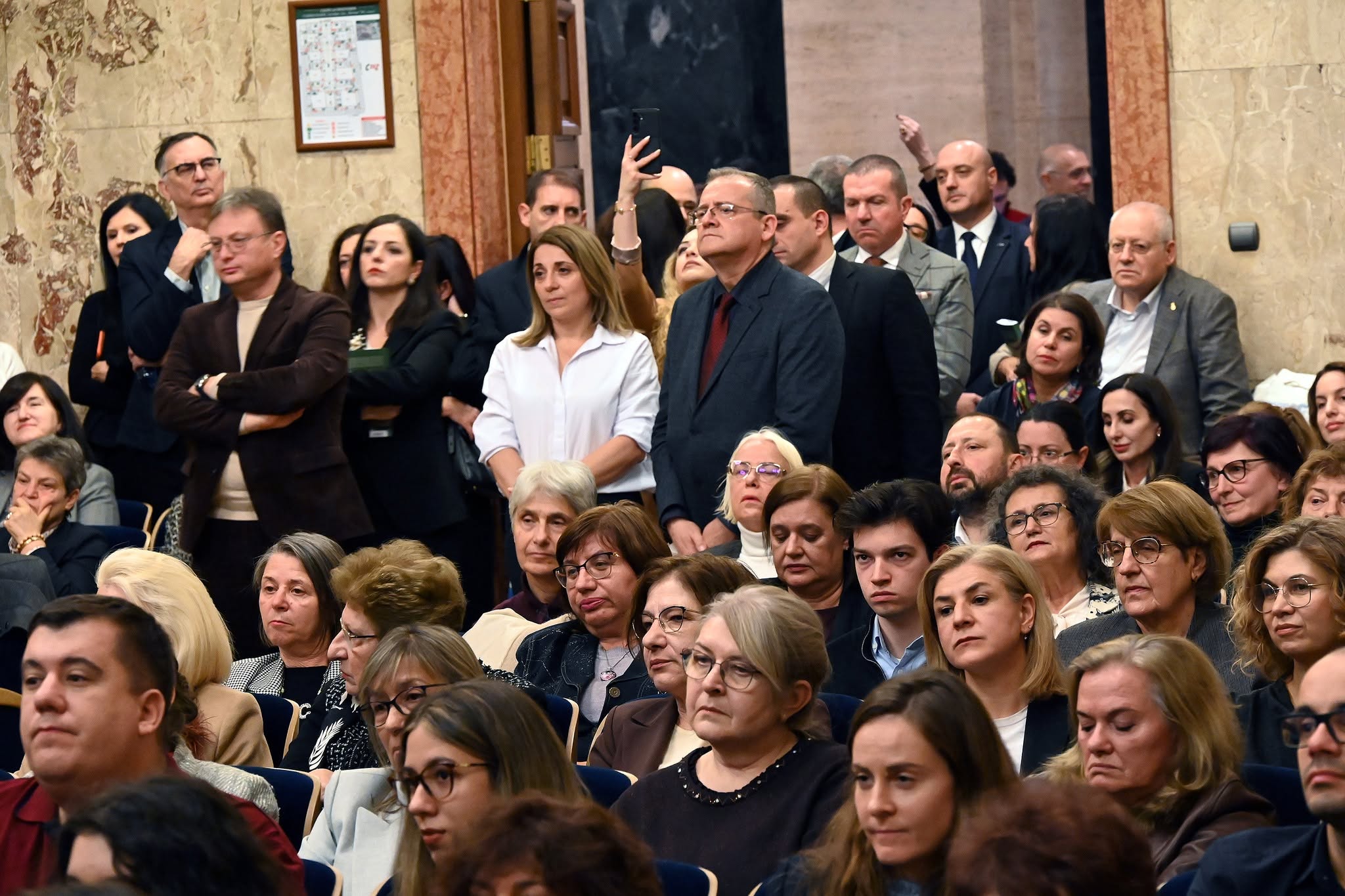
On 26 November 2026, in the packed “Ceremonial Hall“ of the Palace of Justice, the constitutional judges, Corresponding Member Prof. Atanas Semov, PhD, and Dr Krasimir Vlahov, jointly presented their two independent fundamental studies – “Conditions for the Admissibility of a Court’s Referral to the Constitutional Court” (published by St. Kliment Ohridski University Press) and “The Constitution in Civil Proceedings” (published by Sibi).
Over 200 legal professionals attended this joint presentation of academic works by two serving constitutional judges – the first of its kind in Bulgaria. Among the guests at the event were the President of the Supreme Court of Cassation, Galina Zakharova; the Deputy Speaker of the National Assembly, Raya Nazaryan; all serving and numerous former constitutional judges; the President of the Bar Council, Stefan Marchev; and lawyers, Ombudsman Velislava Delcheva, members of the Supreme Judicial Council (SJC), judges from the Supreme Court of Cassation and the Supreme Administrative Court, all courts in Sofia and numerous courts from across the country, members of parliament, academics from the Bulgarian Academy of Sciences, professors from Sofia University and the University of National and World Economy, and numerous lawyers.
The ceremony was chaired by Constitutional Court judge Prof. Dr Yanaki Stoilov, who emphasised that “this is the first time in our country that two serving Constitutional Court judges have simultaneously published monographs on constitutional topics”. He noted that such a presentation of works by two constitutional judges had not been done before and highlighted “both the scholarly depth of the two studies and their direct practical applicability”.
He concluded: “Atanas Semov combines constitutional justice with academic research and teaching, paying particular attention to case law. Krasimir Vlahov, drawing on his experience as a judge at all levels of the judiciary and now at the Constitutional Court, is showing an increasingly keen interest in academic research and the training of students and magistrates. Thus, both are involved in both the application of the Constitution and the study of the legal framework and case law.”
In her opening remarks, the President of the Constitutional Court, Dr Pavlina Panova, emphasised that the event was the fourth in a series of activities to mark the 35th anniversary of the Constitutional Court in 2026 marking the 35th anniversary of the Constitutional Court and drew particular attention to the fact that the two constitutional judges “have not merely adopted the practice of the Constitutional Court – they have lived through it, and to a considerable extent have played a part in shaping it. Following the amendment to the Constitution in December 2023, there were significant changes in constitutional justice – the Constitution was opened to citizens through all the courts. In this way, the Constitutional Court has also opened up its case law to the public – both books are an expression of precisely this openness and make the Constitutional Court’s case law accessible to everyone.” Dr Panova remarked: “I will not hide the fact that this period from 2023 to the present has been a challenge for the Constitutional Court itself. The provision of Article 150(2) of the Constitution, whilst regulating access to constitutional justice, has also created ambiguities and problems in its application.
Over the past three years, courts across the country have submitted 32 requests to the Constitutional Court – by way of comparison, there were 44 requests from the supreme courts over the preceding 32 years. It is clear that the country’s courts are making use of the opportunity for dialogue with the Constitutional Court. It must be acknowledged, however, that the proportion of requests accepted is lower. This raises the question of whether the courts are prepared to submit such requests. These two books provide an opportunity to trace the case law and identify errors in previous requests. They are not compilations of case law, but rather an analysis of all the prerequisites for submitting such a request – and are therefore valuable reading for all legal professionals.”
She emphasised that the ruling of the Court of Justice of the European Union in the ‘Petlichev’ case of February 2026, which is examined in both monographs, had unequivocally confirmed that the Constitutional Court’s requirement for courts to clarify the consequences of the application of EU law before referring a matter to it is fully in line with EU law.
Prof. Dr Emilia Drumeva, a Constitutional Court judge whose term of office has expired, presented Prof. Semov’s work and emphasised that his three-volume study is “a truly significant contribution to Bulgarian constitutional law”, a large-scale academic study and, at the same time, a practical handbook for courts throughout the country.
Associate Professor Dr Tanya Gradinarova presented Dr Vlahov’s work, for which she was also one of the reviewers, and emphasised that it is “a comprehensive and highly topical study devoted to the three main pillars of the interaction between the Constitution and civil proceedings”.
Dr Krasimir Vlahov expressed his deep gratitude to Galina Zakharova, President of the Supreme Court of Cassation, and Daniela Doncheva, President of the Sofia Court of Appeal, for the outstanding organisation of the event “in the symbolic heart of the Bulgarian judiciary”, to all colleagues who attended, and to the two publishing houses. He noted that “this gathering has a professional and thematic focus: dedicated to the law and to books”, and expressed his delight that it had been possible to bring together so many of the most distinguished lawyers, dedicated to the cause of serving the law. “At least in this way, our professional community – otherwise divided by numerous dividing lines – can demonstrate that, in the face of the law, we can stand together.”
The final speaker was Academy of Sciences Corresponding Member Atanas Semov. He expressed his immense gratitude to all “over 200 of the most prominent representatives of the judiciary and academia” and to the two publishing houses which manage to publish academic works and “maintain the sense that there is meaning in academic research”. He also thanked the courts which, in recent years, have submitted requests to the Constitutional Court, thereby enabling the development of case law that clarifies all the conditions for admissibility and thus ensures the effective application of the new provision of Article 150(2) of the Constitution. Finally, he expressed the hope that in the coming years the Constitutional Court would not deviate from this practice, which underpins the constitutional rule of law, and encouraged the courts to boldly submit requests to the Constitutional Court.